
How to give praise at work that feels genuine, builds confidence and motivates people

How to give praise at work that feels genuine, builds confidence and motivates people

Why specific praise at work builds confidence.

One of the things I talk about a lot in confidence conversations is the gap between capability and confidence.

Someone may be perfectly able to do the thing. They may have the skill, the knowledge and the judgement. But their confidence has not caught up yet. So when they are asked to contribute, stretch themselves or try something they are not yet sure about, they do not feel as capable as they actually are.

That is why vague praise often fails.

If you say, “You’re brilliant”, a person who is feeling unsure may reject it immediately. Their brain may say, “No I’m not. What makes you say that?” Very gracious of the brain, as ever.

It can also feel a bit uncomfortable because it is so bound up with identity. “You’re brilliant” asks someone to accept a grand statement about who they are. That is a lot to swallow in the middle of a working day, especially if they were not feeling very sure of themselves to begin with.

Specific praise is different because it gives the person evidence.

Instead of, “You’re great”, try:

“I noticed you made the extra effort on that piece of work and it really paid off.”

Or:

“The way you handled that particular part was effective because you explained it clearly.”

Now the person has something to hold on to. They can connect the praise to their own behaviour. They can see what worked and why it mattered.

That is much harder to dismiss.
How to calm nerves before a work presentation

If you’ve got a work presentation coming up and you’re worried you’ll panic, ramble, forget your words or look foolish, you’re not alone.

I get asked all the time: “How do I beat nerves before a presentation?”

And my answer is always the same. I don’t try to beat nerves.

I don’t think you can get rid of them completely, because we’re all human, right? If you care about doing a good job, especially in front of colleagues, clients, senior leaders or a room full of people, you’re probably going to feel something.

So this blog is not about pretending nerves don’t exist. It’s about how to support yourself really well while being nervous.

Whether you’re giving a team update, presenting to the board, speaking at a conference, taking part in a panel or doing your first proper work presentation, nerves do not have to take over. You can learn to work with them.

Quick answer: How do I calm my nerves before a presentation?

To calm your nerves before a presentation, stop trying to force yourself to feel completely calm. Instead, focus on three things.

First, notice the script in your head. If you’re telling yourself, “This will go horribly wrong” or “I’m going to look like an idiot”, that is not helping you. Catch that thought and change the script.

Second, visualise the presentation going well. Not just the moment you stand up to speak, but the whole run-up to it. Picture yourself arriving, getting settled, starting clearly and doing a decent job.

Third, practise your opening and ending. If you know how you’re going to begin and how you’re going to finish, you give yourself something solid to hold on to.

Then, when you’re in the room, smile, move and pause. Those three things can help you manage the physical feelings of nervousness while you’re presenting.

And afterwards? Give yourself time to recover and reflect on what went well, because that bit matters too.

Are nerves just excitement?

Some people say you should exchange the idea of being nervous for feeling excited.

And yes, that works for about a split second for me.

The feeling does not really go away just because I call it something else. So for me, the better question is not, “How do I get rid of presentation nerves?”

It is: “How do I handle them well?”

That is what this blog is all about.

How to gather insights into confidence and communication skills in my organisation

How to gather insights into confidence and communication skills in my organisation

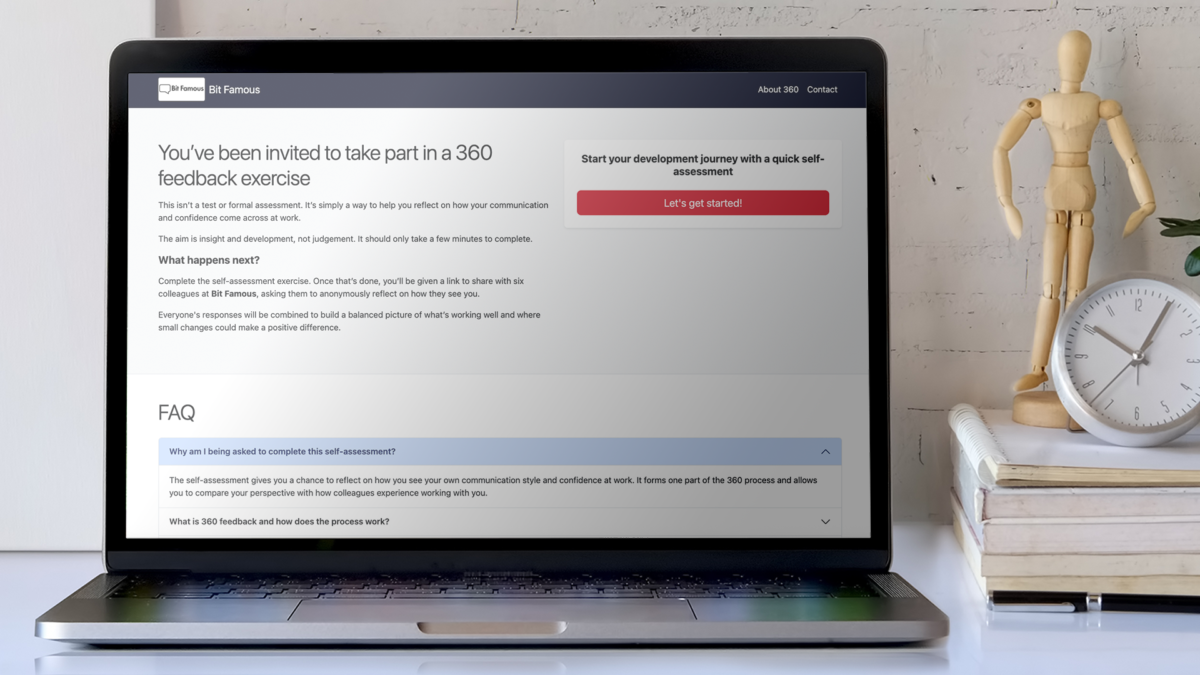
Bit Famous 360 is our online 360-degree feedback tool built to help organisations understand and benchmark their people’s confidence and communication skills.

It makes gathering 360-degree feedback in a simpler, more useful, and far less intimidating way — giving individuals and organisations actionable insights they can actually use.

The tool helps colleagues compare how they see themselves with how others actually experience them:

The effectiveness and impact of their communication skills
Their ability to connect with audiences with clarity
How they represent your organisation
Giving feedback, decision-making and how someone handles a challenge.
If these are blind spots for some of your colleagues, our 360 process will help bring them into view.

The aim isn’t to label people or catch them out. It’s to help them reflect, spot their strengths and find a few areas where small changes could make a real difference.

The tool is also flexible. Question sets can be fully tailored to reflect your organisation, your values and the behaviours that matter most in your world. It can be used with one colleague or several hundred.

How to host a meeting that will set you apart and progress your career

We delve into the art of hosting a meeting, a crucial skill that can significantly impact your career progression. We discuss the difference between just holding a meeting and truly hosting one, and explore various strategies to engage attendees, manage time effectively, and drive productive discussions. This guide will arm you with the tools you need to turn any meeting into a platform for meaningful communication and collaboration.

How low confidence shows up as underperformance at work

How low confidence shows up as underperformance at work

How low confidence shows up as underperformance at work.

Why do capable employees underperform despite having the right skills?

When leaders talk about “low performance”, the conversation often drifts quickly towards capability, motivation or even discipline.

But there’s an alternative explanation that rarely gets named.

Sometimes performance dips not because someone lacks skill, nor because they don’t care, but because their confidence has slipped. It creeps in slowly. It hides behind busyness. It disguises itself as personality. And because it isn’t openly discussed, it’s easy to miss.

A lack of self-belief is a hidden and quiet problem affecting performance. Leaders feel frustrated. They can see that someone is not delivering as well as they could. They know the potential is there. But they’re at a loss as to how to remedy it.

This is where confidence becomes relevant.

Low confidence does not always look fragile. In fact, it often looks the opposite.

It can look like:

* Independence.
* Self-sufficiency.
* Quietness.
* Intensity.
* Reluctance to collaborate.
* Even arrogance.

Take the example of the senior leader who arrived every morning, went straight to their office, shut the door and barely interacted with anyone. The team interpreted that behaviour as aloofness and disinterest. Stories filled the gaps.

In reality, this person was shy. Informal interactions triggered anxiety. Their well-being was low. They dreaded the small talk and unscripted conversations. So they withdrew.

That withdrawal had consequences.

Low visibility meant low influence.
Low influence meant lower engagement.
Lower engagement meant weaker organisational performance.

Confidence and performance are closely linked because confidence affects how visible, collaborative and decisive someone feels able to be.

And when someone’s self-belief drops, you often see a cluster of behaviours emerge. They avoid exposure. They hesitate. They second-guess. They isolate. Decisions slow down. Work requires more redoing. Deadlines start to wobble.

None of this necessarily means someone is incapable.

It may simply mean their self-belief has taken a knock.

Before jumping to conclusions about attitude or ability, it’s worth asking a more curious question:

Could this be confidence showing up as underperformance?

colleague-led learning

Measuring Workplace Confidence – What happens when you teach self-belief?

Does workplace confidence training genuinely change how people feel and work, or does the impact fade the moment the session ends? That’s the question Northumbria University set out to answer when it evaluated the Workplace Confidence Training delivered by Bit Famous to the College of Policing.

To understand what really happens after a session like this, the researchers followed participants over time. They gathered data before the workshop, immediately afterwards and again three months later. This gave them something rare in workplace training: a clear view of both the immediate uplift and the longer-term effects.

The survey results showed measurable shifts in confidence, job satisfaction, peer support and people’s understanding of the tools they’d learned.

The study blended two types of evidence. Alongside the numbers were written comments from participants. These qualitative reflections revealed the human side of the experience: what people remembered, how they used the ideas and what difference it made in day-to-day policing roles.

Mastermind groups in police leadership

Inside the study: what we’ve learned from mastermind groups in police leadership

Inside the study: what we’ve learned from mastermind groups in police leadership.

Study into the success of mastermind groups and peer-led learning. At Bit Famous, we’ve seen first-hand how powerful peer learning can be. When colleagues come together to talk openly about their challenges, swap ideas and hold each other accountable, something clicks. Confidence grows. Problems get solved. People stop waiting for permission and start making things happen.

In May 2025, our award-nominated training with the College of Policing (Finalists: Personnel Today Learning and Development Supplier of the Year 2025) became the focus of an independent evaluation by Northumbria University. The study explored the impact of our Workplace Mastermind Groups programme, which introduces leaders to a practical, peer-led approach to problem-solving and professional development.

The research ran for six months, tracking more than 80 senior police leaders across England and Wales before their training, immediately after, and again three months later.

The findings are fascinating. Participants showed big jumps in understanding how to set up and run mastermind groups, and most felt better supported by colleagues and managers. Job satisfaction and collaboration improved too. Confidence stayed consistently high, suggesting these sessions help people put their self-belief to work rather than simply talk about it.

In short, the research confirms what we’ve always known from experience: when people are given space to learn from each other, they don’t just gain knowledge — they build stronger, more confident workplaces.

Let’s take a look at what the data tells us.

colleague-led learning

How to encourage colleagues to share knowledge, solve problems and learn from each other at work

Colleague-led learning. What if I told you some of the best learning and development in your workplace doesn’t need a big budget, a slick platform or an outside trainer on speed dial?
Sounds unlikely, right? But it’s happening. I’ve just been working with a group at Beazley, a global insurance firm. They didn’t wait around for the “perfect” training course on presentations. Instead, they built their own. A colleague-led club, now 100 members strong, where people practise speaking, swap feedback and support each other to go from “just about okay” to truly compelling.

Workplace confidence resources

The value of val-yous: why reflecting on personal values can boost your colleagues confidence and sharpen decision making

Have you ever dithered over making a final decision on something? Perhaps choosing one candidate over another, or what to do about the kitchen cupboards falling apart!

Maybe you said yes to something, then quickly regretted not saying a firm no. Or you held back when you meant to speak up.

Well, all these moments, internal wobbles, are signs you’ve drifted from your values, the things that really matter to you, that make you you.

Or, more likely, you’ve never had an opportunity to pin down your values..

Now , imagine what happens when a whole team is out of step with their own personal values. It’s not just the odd regret or misstep here and there, it’s multiple people being slower to make decisions, second-guessing why they’re going in a certain direction, not really leaning into being themselves and being brave.

Everyone needs a North Star – and that’s why it’s worth doing a values check-in.

Workplace mastermind groups: How to bring colleagues together to share expertise, solve problems and develop their careers

Introduction: What is a workplace mastermind group?

I want to share an idea with you that’s commonly associated with business owners. Actually, I think it’s something that should be more regularly used in the workplace. That is, mastermind groups at work so your people can solve their problems confidently and build wider networks across the organisation. 

There are loads of reasons why they’re brilliant, and often their outcomes are phenomenal in a way that you’d never expect. I’ll go into those in a little more detail in a minute, but a mastermind group is sometimes also known as an action learning set or peer-to-peer mentoring. 

Shh… The silent workplace confidence crisis

The silent workplace confidence crisis. In my experience, workplace issues around self-doubt are rarely discussed. They’re seen as a private, personal burden to bear.
But I would say confidence is a people problem we can all work to resolve. And it’s a bonus to do so, because confident individuals can build confident organisations, that can fulfil their purpose.
So, the solution is to actively support colleagues to re-establish their confidence and thrive in the workplace.

Outperform and impress: 5 Meeting hosting hacks that will set you apart

We delve into the art of hosting a meeting, a crucial skill that can significantly impact your career progression. We discuss the difference between just holding a meeting and truly hosting one, and explore various strategies to engage attendees, manage time effectively, and drive productive discussions. This guide will arm you with the tools you need to turn any meeting into a platform for meaningful communication and collaboration.

How to be better at speaking up in meetings at work

How to speak in meetings with confidence and authority. Today, I want to discuss a significant problem: a challenge, particularly for women in meetings. I frequently hear this from the people I work with, as they discuss their actions (or lack of them) during meetings. They become bothered and reflect afterwards when things go wrong. Speaking up in meetings, and ensuring people listen to you are valuable skills to learn. Let’s dive into that today. I’m going to start with five points to cover. Let’s see how we go with those.

Slide-free presentations

How to give a work presentation without using slides

Audiences crave a more engaging and interactive presentation experience. I recommend breaking free from over-dependency on PowerPoint to explore innovative ways to captivate your audience.

In this blog post, I’ll guide you through the process of embracing slide-free (or fewer slides) presentations, I hope it’ll give you some ideas to help kick the PowerPoint habit for good.