The simple goal setting tool that sets your team up for success
Let's Talk - Book a no-obligation discovery call
The simple goal setting tool that sets your team up for success. When goals feel too big, too vague or too overwhelming, people stall. They lose momentum. They quietly give up. And leaders are left wondering why bright, capable colleagues aren’t moving forward.
In this episode of the Penny Haslam Podcast, I take a fresh look at goals and how we help others achieve them. Not with grand strategies or complicated systems, but with a simple paper-based tool I use in my masterclasses – one that turns vague intentions into clear, doable steps.
It’s practical. It’s human. And it works because it breaks the habit of setting huge all-or-nothing goals that people abandon the minute real life gets busy.
You’ll hear why small wins matter more than big declarations, how to support colleagues who’ve lost their spark and why confidence grows fastest when progress is visible and celebrated.
This is an easy rethink of how you and your team approach goals – and a shortcut to getting things done.
Jump to: How to use the goal setting pyramid
Why achieving things matters for confidence at work
When I talk to leaders about confidence, I’m always drawn back to something simple: people feel better about themselves when they achieve things. It sounds almost too obvious, doesn’t it? But in the day-to-day rush of work – the meetings, the emails, the urgent stuff piling up in corners – it’s astonishing how often this basic truth gets overlooked. We forget that momentum builds confidence, and confidence fuels performance.
What I’ve noticed, over and over again, is that achievement doesn’t have to be spectacular to be powerful. In fact, the big, dramatic wins tend to arrive only after a long stretch of small, steady steps. But in workplaces, we rarely pause long enough to notice those steps, never mind celebrate them.
And that’s a problem, because when people stop recognising their own progress, their confidence starts to dip. You see it in the colleague who used to be full of ideas but has grown quiet. You see it in the bright new hire who arrived bursting with energy, only to lose their shine a few months in. You see it in people who’ve always been capable but have started doubting themselves, often without anyone realising. As I say in the podcast, life happens – people go through things, confidence gets knocked, and achievement starts to feel harder than it should.
It’s why I place such importance on helping people achieve something – anything – as a starting point. Not a grand transformation or a heroic goal, but a small, meaningful win they can actually complete. Because when someone proves to themselves that they can take one step, the next step feels far more possible. Their shoulders lift. Their tone changes. They show up differently.
And when leaders adopt this mindset, the impact is enormous. Instead of expecting people to leap tall buildings, you help them take manageable steps. You shift the focus away from pass-or-fail goals and towards the confidence-building process of getting things done. It’s not fluffy; it’s practical psychology at work.
This is where the simple tool I share – the goal-setting pyramid – becomes so effective. It’s not magic. It’s not high-tech. It just helps people see their own progress again, often for the first time in a long while. And when people can see progress, they feel more capable, motivated and resilient.
In other words: achievement builds confidence, confidence builds achievement… and the cycle begins.

Bit Famous works with businesses and organisations to help them communicate with confidence.
By Penny Haslam
MD and Founder - Bit Famous
FREE resources for leaders and people professionals from Penny Haslam and Bit Famous
Sign up for my awesome Workplace Confidence email
Share this page









Where people professionals share the great work they do!

Why big goals can be unhelpful or intimidating
I’ve lost count of how many times someone has said to me, “I really should set myself a big goal.” You know the type they mean – the enormous, impressive, slightly terrifying “big, hairy, audacious goal” that looks great on a poster but often feels completely out of reach in real life.
And here’s the truth I share on the podcast: big goals can be brilliant, but they can also be utterly paralysing. We talk about them as if they’re the holy grail of ambition, but for a lot of people, they trigger embarrassment, avoidance or a quiet, creeping sense of failure before they’ve even begun.
Sometimes the goal feels too big. Sometimes it feels too vague. Sometimes we have a sneaky limiting belief whispering, “Who do you think you are?” And very often people start something with enthusiasm, get partway through, stall for perfectly normal reasons, and then judge themselves as if they’ve failed the entire mission. That’s when confidence starts to erode. Not dramatically, but slowly. Quietly. Almost unnoticed.
And it doesn’t just happen to individuals. Leaders see it in their teams all the time. Someone who looked like a high flyer in the interview starts hesitating. Another avoids putting themselves forward. Someone else, who arrived with the confidence of a Labrador puppy, suddenly goes timid and unsure. As I said in the recording, sometimes people lose their lustre simply because life has happened or their confidence has taken a knock.
The problem with giant goals is that they’re unforgiving. They demand big change, big output, big courage – and they leave no room for the messy, human reality of progress. When the only options are “I’ve achieved it” or “I’ve failed”, most people quietly retreat. And when leaders rely only on big goals, they miss the chance to help their colleagues build confidence through achievable wins.
That’s why I’m such a fan of starting small. Not small in impact, but small in steps. Small enough that people can actually take action rather than freeze. Small enough that they can feel what progress feels like again.
When you strip away the pressure of the giant goal and replace it with a process that rewards steady movement, everything changes. People become braver. They try more things. They recover faster when something goes wrong. And – ironically – they’re far more likely to reach the big goal in the end, because they haven’t talked themselves out of it halfway through.
Big goals have their place. But if they’re stopping your team from starting, then they’re not inspiring – they’re intimidating. And there’s a much kinder, more effective way forward.
How confidence dips affect performance in teams
One of the most interesting – and frankly, most human – parts of working with people is noticing how confidence ebbs and flows. You can recruit someone who seems like an absolute star: energetic, articulate, ambitious, full of ideas. You think, brilliant, we’ve found a real go-getter here. And then, a few months down the line, something changes. They go quiet. They hold back. They stop putting themselves forward for things they’d once have leapt at.
In the podcast I talk about this very thing, because it happens far more often than we acknowledge. Sometimes people simply lose their lustre. Not because they’ve suddenly become incapable, but because something – life, workload, stress, a past setback – has knocked their confidence. And confidence is delicate. It can take years to build and moments to dent.
As leaders, we often misread what’s going on. We assume someone has lost interest or motivation. We think they’re underperforming or disengaged. But underneath that behaviour, there’s often a perfectly rational explanation: they don’t feel as sure of themselves as they once did. And when people feel unsure, they shrink their world. Their contribution gets smaller. Their ideas stay hidden. Their potential goes unused.
What makes this especially tricky is that confidence dips rarely announce themselves. No one walks into a one-to-one and says, “Hello, I’m struggling with my self-belief.” Instead, you see it in tiny behaviours – hesitations, delays, overthinking, avoidance. Someone who used to volunteer now waits to be asked. Someone who used to ask clever questions now keeps their mouth shut. Someone who hoped to progress suddenly insists they’re “not ready”.
And the irony is, these are often the very people who impressed you at interview. The people you thought would fly. The high achievers, the self-starters, the ones who looked like they’d take on the world. But confidence isn’t fixed. When it dips, it affects everything: communication, appetite for challenge, how people see themselves and how they show up around others.
This is why I find the small-steps approach to goal setting so powerful. It doesn’t ask people to “turn their confidence back on” – if only it worked like that. Instead, it helps them rebuild belief through action. One tiny step at a time. No drama, no pressure, no judgment. Just a gentle nudge back into momentum.
Because when people start achieving again – even very small things – their confidence naturally follows. And when their confidence returns, so does their spark, their ideas, their presence, and their contribution to the team.
That’s why supporting confidence isn’t a soft concern. It’s a performance concern. And a very fixable one.
The case for focusing on low-hanging fruit
When I’m working with leaders, one of the first things I encourage them to do is stop reaching for giant, transformational goals and start looking for what I call the low-hanging fruit. The easy wins. The small, doable steps that people can take without feeling overwhelmed or exposed.
Because in the podcast, I say very clearly: I’m not talking about big, life-changing goals that end with you being carried out of the office on everyone’s shoulders. Not everything has to be heroic. In fact, very few things should be.
Why? Because small steps are the secret to real progress. They’re achievable, they build momentum and most importantly, they are confidence-building. When someone takes a small step and sees it work, they get a tiny hit of belief. “Oh, I can do this.” And that’s the beginning of a very different trajectory.
It’s also why I love the goal-setting pyramid so much. It’s a tool designed to remind us that the path to achieving anything is made up of lots of small bricks. Steps that in themselves are valid, praiseworthy and worth acknowledging. But in modern workplaces, we skip past these moments. We chase the outcome, the big finish, the ta-da moment… and we miss the tiny, powerful pieces that get us there.
And when leaders ignore those smaller pieces, people feel it. Colleagues doing good work day after day get very little recognition for it. Those who are making progress quietly don’t hear anything about it. And those who are stuck feel even more stuck because the distance between where they are and where they “should” be looks enormous.
But when you deliberately look for low-hanging fruit – the tasks they can do, the steps they can take – three things happen:
1. They start moving again. Even the smallest tick on a list pulls people out of stagnation.
2. They feel seen. Someone’s noticing their effort and progress.
3. They build belief. Because achievement, no matter how small, is emotionally rewarding.
And let me say this clearly: low-hanging fruit isn’t lowering the bar. It’s clearing the path. It’s removing unnecessary friction. It’s showing people that success isn’t about giant leaps but steady steps.
When leaders take this approach, everything softens. People become less frightened of failing. They become more willing to try. They rediscover their energy. And that’s when you see the real magic: small steps accumulating into something big, sustainable and meaningful.
This is why low-hanging fruit matters. Not because it’s easy, but because it works.
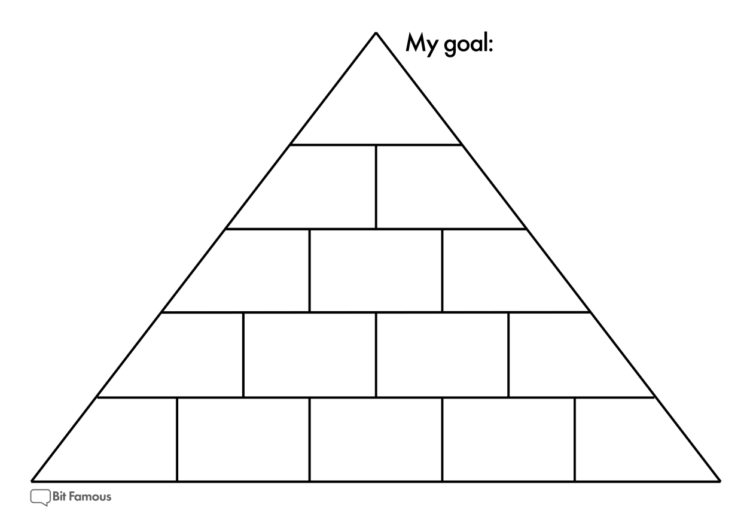
David Hyner's Goal Setting Pyramid
Introducing the goal-setting pyramid
Let me introduce you to one of my favourite confidence-boosting tools: the goal-setting pyramid. It’s gloriously simple, wonderfully low-tech and, in my experience, far more powerful than any fancy app or spreadsheet. In the podcast I describe it exactly as it is: a big triangle drawn on a piece of A4 paper, filled with little brick-like squares that represent all the steps you’ll take towards a goal.
It’s not pretty. It’s not corporate. It doesn’t sync with anything. And maybe that’s why it works.
I first learned about this version of goal setting from David Hyner, who teaches it in far more depth. I’ll be honest: I never used the full, detailed method he teaches because I was too time-poor at the time. But I did cling firmly to the essence of it – the visual simplicity, the tactile experience, the way it breaks a goal into pieces that feel doable rather than daunting.
Here’s how I describe it when I run this exercise in my workshops. Grab a sheet of paper, turn it landscape and draw a big triangle. Then draw horizontal lines across it, like layers of a cake. Now divide each line into little rectangles, like bricks in a wall – the kind you used to draw at school. Before you know it, you’ve got a pyramid of tiny boxes, each one ready to hold a step, an idea, or an action.
This is where the magic happens. At the top, on the right-hand side, you write your goal – whatever it is. A work ambition, a new skill, a project you’ve been avoiding, a personal task you’ve been putting off for years. And then, brick by brick, you fill in the steps you could take to get there. There’s no order. No sequence. No progression you have to stick to. It’s not snakes and ladders. You don’t “fail” if you don’t complete a row.
You simply wake up, look at the pyramid and pick a brick you fancy doing.
That’s it.
And what I love about this is how human it is. When people use this tool in my masterclasses, something shifts in the room. They stop thinking about the giant, overwhelming thing that’s been looming over them and start spotting the smaller, achievable bits they can get on with. They see possibilities instead of problems. They see progress before they’ve even taken action.
The triangle makes goals feel less mysterious and more manageable. It offers a structure without pressure. A visual anchor that says, “You don’t have to do everything today, but you can do something.”
It’s simple. It’s tactile. And it’s surprisingly transformative.
Why writing goals on paper works
One of the things I love most about the goal-setting pyramid is that it lives on paper. Actual, honest-to-goodness paper. In a world where everything ends up on a spreadsheet, an app or a project management system, this might sound quaint… but there’s something powerful about taking a pen and physically writing things down. And in the podcast, I talk about exactly why that matters.
When you write something by hand, your brain pays more attention. It makes a stronger connection. The act of forming the letters forces you to slow down and think. It goes into your memory differently, and it continues working in the background – even while you sleep. You’re essentially planting a suggestion in your own mind: “This matters. Keep cooking on it.”
And because it’s a physical object, you have to put it somewhere. You blu-tack it to the wall above your desk, stick it on the fridge, wedge it by your monitor – anywhere you’ll see it regularly. That visibility does something important. Every time your eyes land on it, your brain registers the goal and all the little steps you’ve mapped out. You don’t have to “remember” to remember. The paper does the reminding for you.
It’s the opposite of what happens with digital tools. Digital things get buried. Out of sight, out of mind. Tucked away behind tabs, notifications and inboxes. Before you know it, your goal is lost somewhere between Slack alerts and meeting reminders.
But when your pyramid lives in the real world, it nudges you gently every day. And it’s never judging you. You don’t have to start at the bottom. You don’t have to follow an order. You just pick a brick, any brick, and get going. That ease is part of why I call it the lazy woman’s approach to goal setting. It’s forgiving. It’s human. It allows you to choose what you feel capable of that day.
And here's something else: when you tick off one of those bricks, it feels brilliant. Because the progress is visible – you can literally see the pyramid filling up. A digital tick in a tiny box on a tiny screen doesn’t quite hit the same way.
So yes, I’m a big fan of keeping this analogue. Pen, paper, triangles, bricks, blu-tack. It’s simple and it works because it strengthens your connection to your own goals. And that’s where confidence starts: in the small moments where your brain and your intention meet.
How to use the pyramid (no order, no snakes-and-ladders thinking)
One of the biggest misconceptions about goal setting is that it has to be linear. Start here, finish there, follow the steps in the correct order and hope you never fall behind. But that’s exactly the mindset that makes people stall. It turns goals into a pass-or-fail exercise. And as I say in the podcast, this pyramid is not a giant game of snakes and ladders. You don’t slide down to failure if you miss a step.
The beauty of the pyramid is that you can work on it in any order you like. Each brick is just one possible action – a small, manageable step towards your goal. And you don’t have to start at the bottom or “earn” your way upwards. You simply wake up, look at the pyramid and choose the brick you feel capable of tackling that day.
Some days you might have loads of energy. You feel bold, you feel brave, you feel like the world’s most capable version of yourself. On those days you might pick something outward-facing – making a call, reaching out to a contact, booking a meeting, taking a step that involves being seen.
On other days, you might feel quieter. Shyer. More introspective. That’s when you pick a brick that’s inward-facing – reading an article, watching a TED talk, drafting a few ideas, doing a bit of research. These tasks move you forward too. They count. They matter. And they’re often the ones people forget to acknowledge.
This is why I describe my own approach as the “lazy woman’s way” to goal setting. Because I don’t force myself to do certain bricks on certain days. I don’t berate myself for not doing them in order. I honour how I actually feel. And that turns out to be surprisingly effective. You move at your own pace, but you do move.
When I run this exercise in my workshops, I see people relax the moment I tell them they can choose any brick they like. Suddenly the pressure drops. They stop thinking of goals as mountains to climb and start seeing them as a collection of doable steps. They realise they don’t have to be perfect. They just have to take action – any action.
And that’s the whole point. The pyramid isn’t a rigid system. It’s a structure that supports momentum. It gives people permission to start anywhere, progress anywhere and succeed in ways that feel manageable and confidence-building.
No order. No rules. No snakes. No ladders. Just steady, human progress.
The Yeti idea: “I can’t do it… yet”
One of my favourite little confidence tricks is something I use in my workshops all the time. It’s simple, slightly silly and incredibly effective. I call it the Yeti idea. And it comes from noticing how often people say, “I can’t do that.” Full stop. End of story.
But when you add one tiny word – yet – everything softens.
“I can’t do that… yet.”
Suddenly the sentence has hope in it. Potential. Possibility. The door is no longer closed; it’s just not open yet. In the podcast I talk about how, when I introduce this idea, everyone becomes a “yeti” – someone who hasn’t mastered a thing now, but absolutely can with the right steps.
And that’s where the pyramid comes in. Because if you say “I can’t do it yet,” the next question is, “Alright then, what are you going to do about that?” And that’s when the bricks start filling up.
Maybe you’ll read a book on the topic.
Maybe you’ll watch a TED talk.
Maybe you’ll ask a colleague for advice or coaching.
Maybe you’ll grab a coffee with someone who’s doing the thing you want to do.
Maybe you’ll sign up for a qualification or a short course.
Maybe you’ll do a bit of quiet research before you even tell anyone you’re thinking about it.
All of these are valid steps. They’re confidence builders as much as they’re skill builders.
And I love that this approach covers every type of goal. In the transcript I use workplace examples – progressing your career, improving a skill, completing a project – but people also use this at home. Things like finally decorating the hallway you’ve been ignoring for two years. It doesn’t matter what the goal is. If you add the word “yet”, you create permission. Permission to start, permission to be imperfect, permission to be learning rather than failing.
What people often need isn’t capability – they already have plenty of that. What they need is permission to be a beginner again. Permission not to know everything from day one. Permission to take the first step without having figured out the fiftieth.
The Yeti idea gives them that permission.
The pyramid gives them the structure.
And together they give people something even more valuable: the confidence to begin.
Examples of workplace and personal goals
One of the things I love about the goal-setting pyramid is how versatile it is. People use it for professional ambitions, personal projects and everything in between. In the podcast I talk about this range, because it shows how universal the tool is – it doesn’t care whether the goal is big, small, career-changing or completely domestic.
At work, the goals people bring to my sessions are often about growth or visibility. Someone wants to run a webinar for clients but keeps hesitating because they’re convinced it will fail. Another wants to lead a meeting or present at an event but feels too junior, too senior, too inexperienced or simply too shy. Others want to build a network, develop expertise, gain a qualification or push a project forward that’s been sitting in the “too difficult” drawer for far too long.
These are brilliant goals – meaningful, confidence-building and completely achievable. But fear of the unknown, fear of failure or just the sheer size of the thing can stop people taking the first step. And that’s where the pyramid is helpful. It lets them break the goal down until the first few actions feel small enough to try.
But it’s not just work-related goals that benefit from this approach. People often use their pyramid for personal things they’ve been avoiding. In the podcast I mention the classic example: the hallway that’s been plastered for two years but never decorated. It’s such a relatable scenario. You know you want to refresh it, but then you get stuck on the details – paint or wallpaper? What colour? Who’s going to do it? And when? Before you know it, two years have passed and the hallway still looks like a building site.
Those personal goals matter too, because the psychological blocks are the same. The discomfort, the uncertainty, the “I’ll think about that later” paralysis. And the boost you get from finally tackling them is just as real. When you map a personal goal on the pyramid, the first brick might simply be “pick a colour”. Then “look at paint samples”. Then “get a quote” or “block out a weekend to do it myself”. They’re tiny steps, but each one chips away at the resistance.
What all these examples have in common is this: most people don’t struggle because they lack the skill, the intelligence or the desire. They struggle because they don’t know where to start. The pyramid takes away the enormity of the task and replaces it with clarity – a pathway of small, doable actions.
And once you’ve taken one of those actions, something shifts. You feel productive again. You feel capable again. That little click of progress is exactly what confidence feels like.
It doesn’t matter whether the goal is running a webinar or painting the hallway. The process works the same way, and the confidence payoff is huge.
Why people hold back on goals
The more I work with people on confidence and goal setting, the more I realise that most of us aren’t held back by a lack of ability. We’re held back by the stories we tell ourselves about what we can’t do. And in the podcast I explore exactly why this happens, because it’s rarely about competence and almost always about emotion.
Fear of failure is the big one. We’d rather not start than risk starting and getting it wrong. It feels safer to stay still than to try something and discover it’s harder than we imagined. Even tiny tasks can trigger that discomfort. You’d be amazed how many people tell me, “I want to do a presentation this year, but I just can’t,” or “I want to lead that meeting, but I’m not ready,” or “I don’t have enough experience,” or the classic, “I’m too shy.” These aren’t factual statements. They’re emotional defences.
And then there’s fear of the unknown – the “what ifs” that stop us in our tracks. What if it doesn’t work? What if people judge me? What if I look out of my depth? What if I try… and then I’m stuck? That discomfort is powerful. It convinces us that the safest thing to do is delay the goal until we magically feel braver.
Sometimes the barrier is identity. People think they’re too junior to lead, too senior to learn something new, too established to ask for help or too inexperienced to step up. But those labels aren’t real. They’re internal scripts people have absorbed over years.
And then there’s simple timidity – that quiet, shrinking feeling that says, “Not today.” It doesn’t mean someone isn’t ambitious. It just means their confidence has flickered a little. Confidence is not a constant state; it changes with energy, workload, life events, hormones, sleep and a hundred other tiny factors.
What matters is this: these doubts are perfectly normal. Everyone feels them. I’ve felt them. Every leader I’ve coached has felt them. Every brilliant, talented, high-performing person I’ve ever met has felt them. But because we rarely talk about them, people assume they’re alone. And when you think you’re the only one feeling uncertain, you’re far more likely to hold back.
That’s why the pyramid is so liberating. It doesn’t ask you to suddenly feel bold or fearless. It just asks you to write down a few small steps. And once you have those, the excuses start to loosen. The fear shrinks. The unknown feels less unknown because now you’ve mapped part of it out.
Goal setting isn’t about perfection or bravery. It’s about movement. It’s about gently edging past the voice that says “I can’t” and replacing it with one that says “maybe I can – here’s where I’ll start.”
And when people take that first step, everything opens up.
Outward vs inward tasks
One of the most useful insights I’ve learned about goals is that not all actions feel equally possible every day. Some tasks require you to be outward-facing – confident, communicative, ready to interact with the world. Others are inward-facing – quieter, reflective, solitary. And in the podcast I talk about why this distinction matters, because it can completely change your relationship with progress.
There are days when I wake up feeling brilliant. Clear-headed. Bold. Extroverted. On those days I can email anyone, call anyone, pitch anything, put myself forward without hesitation. Those are my outward days. The days where I tackle the actions that involve speaking up, reaching out or asking for something. They’re important bricks in the pyramid, because outward actions often accelerate progress.
But then there are the other days. The shy days. The tired days. The “I don’t feel very shiny” days. And when I’m having one of those, the thought of sending a bold email or making a brave phone call feels completely out of reach. Not because I don’t want the goal, but because my energy just isn’t aligned with that kind of task.
For years, I assumed this meant I wasn’t being productive. But that’s not true at all. Inward days have their place. They’re the perfect moment for the quieter tasks – watching a video, reading an article, brainstorming ideas, doing a little research, sketching out a plan, drafting something privately before showing it to anyone. Those actions still move you towards the goal; they just require a different kind of headspace.
What the pyramid does is give you permission to honour both types of days. Instead of forcing yourself to “push through” when you’re not feeling it, you simply choose a brick that suits your energy. That flexibility is part of what makes the tool so effective. You keep moving without burning out or berating yourself.
When I teach this in workshops, you can feel the relief in the room. People realise they don’t have to show up as their boldest, bravest self every single day. They can make progress quietly. They can make progress loudly. They can make progress however they happen to feel.
And here’s the best bit: progress is progress. Your confidence doesn’t care whether the action was outward or inward. It only cares that you took a step.
This is how people build resilience and momentum – by choosing the right kind of action for the day they’re actually having.
Example 1: The client who wanted to run a webinar
One of my favourite examples is about a client who’d been sitting on the idea of running a webinar for almost a year. Not a complicated webinar. Not something outside his area of expertise. Just a simple, live learning session for clients where he’d talk about a topic he knew inside out. But despite all that, he couldn’t bring himself to do it. He kept telling himself he was too busy, or it wouldn’t work, or it would flop. Deep down, though, he was frightened it might fail.
I see this so often. People who are perfectly capable – in fact, more than capable – but who’ve put a perfectly good idea into the “too difficult drawer” in their desk. And there it sits, getting heavier and more guilt-inducing by the week.
During one of my workshops, we got everyone working in pairs on their goal-setting pyramids. This client sat with a colleague and started filling in his bricks: the small things he’d need to do to bring the webinar to life. Choose a date. Pick a topic. Draft an outline. Ask marketing for support. Check the tech. Create a sign-up link. Suddenly, he realised something important: he was already halfway there.
That’s the power of writing it down. He had already done so much of the work in his head but hadn’t given himself credit for any of it. Once he could see the steps on paper, the whole thing stopped feeling impossible and started feeling exciting again.
He told me afterwards that the pyramid had “reignited” his enthusiasm for the idea. That’s the word he used. Reignited. And it’s absolutely right. The pyramid didn’t magically give him new skills or more time; it simply gave him clarity. It showed him that his goal wasn’t a mountain. It was a series of small stones he could step over.
He and his partner even agreed to hold each other accountable for the steps they’d written down. That accountability alone lit him up. The boulder he’d been dragging around – that heavy sense of “I should have done this by now” – suddenly felt lighter.
This is what I love about the tool. It takes something that feels burdensome and turns it into something manageable. Something energising.
By the end of the session, he wasn’t just willing to run the webinar. He was excited about it.
And that’s the shift we’re looking for.
Example 2: The client who wanted confidence chairing panel discussions
Another story I share is about a client who came to me because he wanted to get good at chairing panel discussions. Not just “competent enough to get through it,” but genuinely confident. He wanted to be seen as an industry expert – someone who could handle complex topics calmly and thoughtfully, and guide a panel with authority and warmth. But here’s the thing: he didn’t feel confident at all. In fact, he felt the opposite.
He’d made this a goal for himself but hadn’t taken any real steps towards it because the whole thing felt too big. Too exposed. Too risky. So, we sat down and used the goal-setting pyramid to break it down.
What does someone need to do to feel confident chairing a panel? Well, first: information. He needed to understand the skills involved, so that meant some guidance from me. Then observation – watching others in action and deconstructing what worked. What did he like about their style? What didn’t land? What could he adopt or adapt?
Then there were the practical, outward-facing steps: connecting with event organisers, making himself visible to marketing teams, telling people, “Hey, I’d love to chair one of our panels.” Those are bolder bricks, of course. They require courage. They require a bit of brave-pants energy. But they belong on the pyramid all the same.
And then the reflective steps: getting feedback after each panel he did do, learning from mistakes, noticing what helped him feel grounded or flustered, and adjusting accordingly.
None of these steps are glamorous. There’s no certificate for “watched a discussion and took notes” or “told the marketing team I’m up for it”. But they are essential. They build confidence in layers.
Now here’s the part I love most. Two years later, he told me that he’d been asked, at the very last minute, to step in and chair a panel because a colleague had fallen ill. It was a Sunday. The panel was Monday. Two-years-ago him would have said a firm, panicked “absolutely not”. But this time? He said yes. And he did a brilliant job. He was calm, confident and genuinely enjoyed it.
That’s the real power of small steps. You don’t always notice the confidence building day to day. But when the moment comes, you realise you’re ready.
That’s a goal achieved. And not because he suddenly became fearless, but because he’d quietly built the skills and belief to step forward.
Why leaders should use this goal setting tool in one-to-ones
Whenever I’m working with managers or senior leaders, something becomes clear almost immediately: they want their people to progress. They want them to grow, to develop, to step into bigger roles, to feel good about the contribution they’re making. But often they’re unsure how to actually help someone get there in a way that feels structured but not overwhelming.
And this is exactly where the goal-setting pyramid earns its place.
In the podcast, I talk about how powerful this tool is when used in one-to-ones. Imagine sitting with a colleague who’s trying to learn a new skill or get to grips with a piece of technology, or maybe they’re thinking about applying for a new role. They’re motivated, but unsure. Keen, but hesitant. They want to move forward, but the goal feels woolly, complicated or distant.
Now picture the two of you sketching out a simple pyramid together.
Brick by brick. Idea by idea.
Suddenly there’s a plan. Not a corporate performance form or a rigid development document, but something human. Something they can see. Something you can both return to next time you meet.
And here’s why it works so beautifully:
It makes progress visible
People can literally see what they’ve achieved since you last spoke. Even one or two bricks ticked off can shift their confidence.
It encourages better conversations
Instead of, “So… how’s it going?”, you have something concrete in front of you. You can ask, “Which bricks felt easy? Which felt hard? Which one do you want to choose next?”
It lets you praise the right things
We often only praise the big outcomes, but confidence grows in the small steps. Leaders who notice and name those steps help people feel supported, not judged.
It strengthens accountability without pressure
The pyramid isn’t a whip. It’s a map. It helps people hold themselves accountable while knowing you’re there to support, not scrutinise.
It builds confidence through action
And that’s the heart of it. Confidence isn’t built through pep talks; it’s built through doing. One brick at a time.
I’ve used this tool with so many clients – from emerging leaders to senior executives – and the feedback is always the same: it makes development feel doable. It gives people agency. It gets them unstuck.
And when someone feels supported and sees their own progress, everything else becomes easier: communication, creativity, performance, leadership. The pyramid might be simple, but the impact on the relationship between a leader and their team member is anything but.
How I use the pyramid personally
Whenever I teach the goal-setting pyramid, people often assume it’s something I suggest other people do. But the truth is, I use it myself. A lot. In the podcast I even mention that I’ve got a whole folder full of these pyramids, some for big aspirations, some for the small but meaningful things that make life easier or lighter.
I’ve used the pyramid for huge professional goals – writing my first book, for example. That wasn’t a tidy, linear project. It was a mess of ideas, drafts, rewrites, confidence dips, surges of energy and late-night bursts of clarity. The pyramid helped me see that progress wasn’t about “finish the book” but about taking the next step… then the next… then the next.
I’ve also used it for building whole strands of my business, like establishing my executive coaching work. There were hundreds of little actions involved in that: designing programmes, refining the offer, reaching out to people, creating resources, testing sessions, gathering feedback. Putting them onto a pyramid gave me structure without rigidity. It helped me stay connected to the goal without feeling swallowed by it.
And then, at the other end of the spectrum, I’ve used the pyramid for tiny goals like “lose half a stone before Christmas”. I talk about this in the recording because it’s such a relatable example. If you’ve ever faced a festive season armed with cheese boards, puddings and the odd cheeky glass of port, you’ll know that a small head start helps. But again, it wasn’t about perfection. It was about noticing the small choices that would get me there. A walk here. One less mince pie there. Brick by brick.
That’s what I love about this tool: big goals, small goals – it doesn’t discriminate. Anything that matters to you can go on that pyramid.
And because it’s all written in your own handwriting, on paper, it feels personal. It feels grounded. It’s not an abstract target floating around your inbox. It’s a physical reminder of what you want and what you believe you can do, sitting right where you can see it.
It’s easy to think leaders or speakers or coaches have some magical ability to stay motivated all the time. We don’t. We wobble too. We doubt ourselves. We procrastinate. We avoid. The difference isn’t confidence – it’s the tools we use to rebuild it.
The pyramid is one of my favourite tools to use. And it’s one of the reasons I’m so passionate about sharing it.
The central message
When you strip everything back – the examples, the stories, the diagrams, the bricks and the triangles – the central message of this entire approach is beautifully simple: progress builds confidence, and confidence builds progress. It works in a loop. A gentle, human loop.
In the podcast, I make the point that people so often set themselves up for failure by choosing goals that require a dramatic, pass-or-fail outcome. That’s a confidence killer. Because life rarely unfolds in a straight line, and the moment you slip or stall, you tell yourself the whole thing has failed.
But when you switch to small steps – meaningful, visible steps – everything changes. The steps are rewardable. They’re worth celebrating. They show you that you’re capable of movement, even when the movement is tiny. That’s what the pyramid does so well. It makes the invisible visible.
This is why the tool is so helpful in workplaces. People don’t need more pressure. They need more clarity. They need more moments of “I did that” to rebuild belief. They need leaders who recognise the small wins and remind them that progress is happening, even if the big moment hasn’t arrived yet.
What I’ve seen again and again is that when people use the pyramid, they stop thinking in terms of “am I succeeding or failing?” and start thinking in terms of “what can I do next?” That shift alone can completely transform how someone feels about themselves and their work.
And once they feel that shift? They don’t just achieve more. They become more confident, more resilient, more willing to try. They become the kind of colleague who steps into opportunity instead of shrinking back. They rediscover their spark.
That’s the heart of this whole approach:
Small steps aren’t small. They’re everything.
Let's Talk - Book a no-obligation discovery call