Gender pay gap action plans – what does meaningful action look like?
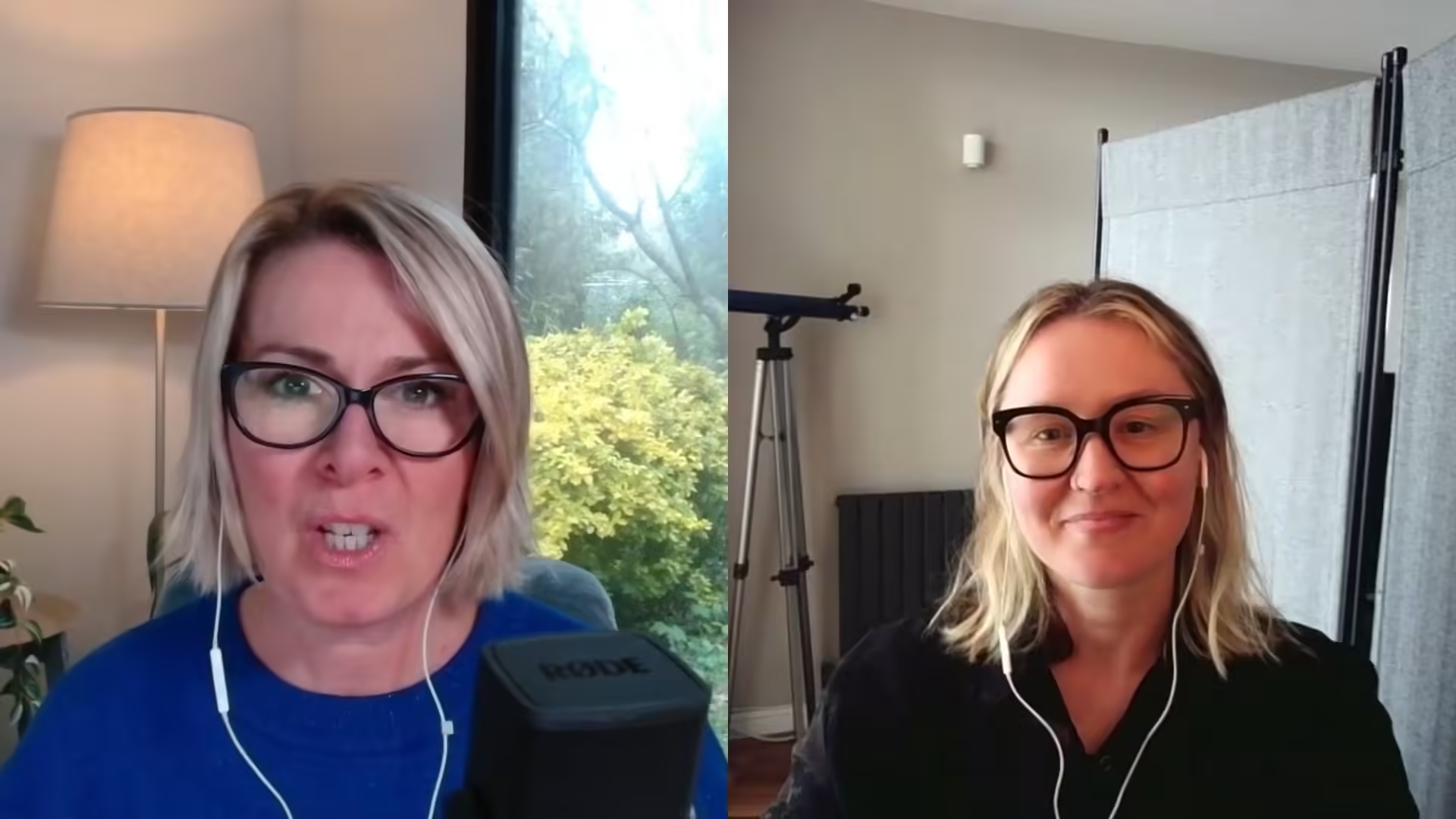
Gender pay gap action plans - what does meaningful action look like? In this episode, I chat with Gillie Fairbrother, Global Responsible Business Officer at Davies, about what a gender pay gap action plan actually looks like in practice — and why employers really do need to get on with it.
She oversees ESG at Davies, a global professional services and technology business, and brings a really grounded, commercial perspective to everything she discusses.
Employers with 250 or more staff are being encouraged to explain what they are actually doing to close their gender pay gap and support employees experiencing menopause. We discuss what meaningful action looks like in practice — and how organisations can finally move beyond just publishing the numbers.
For Gillie, the timing really matters. She told me it is about asking harder questions and getting much more specific about what will actually change things.
As she put it in our chat, “People will no longer be able to get away with saying things like, ‘we will consider’ and ‘we aim to’. It’s now about: how are you going to do it, and how is that going to impact?”
Why gender pay gap action plans matter for employers, investors and clients
She makes the point that many employers have been publishing gender pay gap figures for years — but just putting the numbers out there is no longer enough. The real question, she said, is whether leaders actually understand what is behind those figures and are willing to act on them.
In her words, “I think what the government is looking for are those key drivers that explain the gender pay gap. What do these numbers really mean, and why are they where they are?”
She also points to the commercial pressure building here, particularly from clients, investors, and ESG assessors. As she put it, this is not just the right thing to do anymore — it is becoming a business issue.
In short, gender pay gap reporting is showing up everywhere organisations are assessed — and people are starting to notice.
What a stronger gender pay gap action plan should look like
She is pretty direct about this: vague promises and one-off initiatives won't cut it. Companies need to take their data seriously, own the decisions and follow through.
She tells me she would love to see businesses use this moment to properly understand where the issues actually sit — whether that is in specific teams, grades or divisions — and then respond in a much more targeted way.
She’s clear on this point: “So instead of just pumping out the numbers, it’s about understanding those numbers and then making really strategic decisions about how you might change.”
Menopause, management and workplace culture
We also get into menopause support, and Gillie is pretty passionate about this one. It should not be a niche or awkward topic — and organisations need to be bring managers and leaders into these conversations, not just women.
“How can we upskill team leaders and managers, including male managers, so they feel less frightened of this topic?” And she made a great point — hybrid working has already proved that organisations can adapt when people need flexibility.
“We know it works, so why should it be any different here?”
Why gender pay gap action is everyone’s job
Something that kept coming up in our conversation was the idea that this work cannot just live in one team or one report. Gillie is really clear on it: you do not get culture change unless more people feel like it is their problem to solve.
As she explained it to me, “We don’t want to be a business that has a sustainability team or a business that has a culture team working over here on a culture initiative. We want to be a diversely cultured business that is sustainable.”
She told me that the same thinking applies directly to gender pay gap action. This is not just an HR issue. It is for leaders, managers, and, honestly, anyone who wants to play a part in shaping a fairer workplace.
Her challenge to everyone listening: “Even if you don’t think this is your job, is there some way you could make an impact?”
FREE resources for leaders and people professionals from Penny Haslam and Bit Famous
Share this page
Leadership visibility and influence through confident communication
Read more- Leadership development

New leader, old baggage: how to build trust in a troubled organisation

How to help leaders talk about the things that matter in a way that sounds clear, confident and human
Why do I still doubt myself even though I’m a senior leader?
Gender pay gap action plans – what does meaningful action look like?
Gender pay gap action plans: why visibility and strategic confidence are key to success
Why does my team go quiet when I walk into the room?

Communicating upwards: why won’t my message land?

Is your town hall meeting in trouble?

Visible leadership mistakes and how to avoid them
How to give a farewell speech that shows real leadership

Visible leadership: The coffee strategy
5 Warning signs that your team needs executive coaching
How to be better at speaking up in meetings at work

How does coaching work?
How do I know if I need coaching?
Where people professionals share the great work they do!
Transcript: Gender pay gap action plans - what does meaningful action look like?
What is a gender pay gap action plan and why does it matter now?
PH (00:01.784)
Hello and welcome to the Workplace Confidence podcast. I'm Penny Haslam. And in this episode, what is a gender pay gap action plan and how do you create one? At the time of recording, April, 2026, employers with 250 or more employees are being encouraged to publish what they're doing to close their gender pay gap.
and support employees experiencing menopause. The expectation is this may become mandatory in 12 months time. So joining me to demystify this is friend of the podcast, Gillie Fairbrother. She is the global responsible business officer at Davies, a global professional services and technology company. And it's Jilly's job to oversee ESG. So this strongly fits in her
wheelhouse as we might say. She calls herself the air traffic controller for responsible business. Please welcome to Gillie. Gillie, hello.
Gillie Fairbrother (01:08.63)
So great to be back Penny, thank you for having me.
PH (01:11.224)
Good, it's an absolute pleasure. You're always a dream to talk with, I have to say. So I knew you would be a brilliant person to help us understand what this kind of new voluntary aspect of the Employment Rights Act has changed to. Can you just give us a bit of an outline as to what the changes are, what's expected now of companies?
Gillie Fairbrother (01:32.642)
Totally, and of course not just from a professional standpoint am I interested in this topic, but personally as a woman, they're topics that are very close to my heart and I have a vested interest in us improving in this space. So very happy to talk about this. And as you mentioned,
UK regulation that's coming in or legislation that's coming in for companies of 250 or more employees to step up their actions. So they've been reporting for a while now on their gender pay gap, but now the expectation is to explain what it is they're going to do to make a difference here, which I think will be really interesting.
PH (02:10.776)
Yeah, so what do you think people will be reporting upon and how will we know if it's of any quality what they've put down as their action plan? I mean it might be three sentences like we held a seminar, we sent out a pamphlet and there's a portal on the website to help. I mean what's going to constitute as great?
Moving from gender pay gap reporting to real accountability
Gillie Fairbrother (02:30.909)
Yeah, and I, you know, we've talked about this before. I think there's that the expectation to report isn't changing. So I don't think anyone should turn around and think.
you know, this is something that we haven't known about. And probably if people are actually reading their reports, they should have really been thinking for a while now, what are we doing to change this? And I think what the government is looking for are those key drivers that explain that gender pay gap. So what do these numbers really mean and why are they where they are? Committing to concrete actions. So what are you doing? And I think we'll probably get into a little bit later about how do you link that action to
change in your gender pay gap, but also identifying accountability. Do you have senior leaders or is this a report that's happening and being pumped out from your HR system but no one in leadership is really aware of what these reporting requirements are, what the risks are around not seeing any change in these numbers? So I think that's where we're stepping from a just a reporting requirement to a need to make some action.
How ESG ratings and investor pressure are raising the stakes on gender pay
PH (03:36.63)
Yeah, and I would imagine it brings issues like reputation into focus and also if you are a company that's maybe looking for private equity investment, how does your ESG rating look? And you know, there's a bit more detail under the bonnet now, isn't there, with the action plan reporting. Have you got anything to say about those sorts of risks for companies and if that sharpens everyone's minds a little bit more?
Gillie Fairbrother (04:03.741)
Absolutely and this is something we're assessed on on a daily basis whether that be through a client bid, an RFP, an investor assessment, a lot of companies using rating agencies like Ecovardis which their clients mandate that directly ask us questions about this.
PH (04:19.478)
Every day they're asking, they're interested. There's real pressure then, yeah.
Gillie Fairbrother (04:21.921)
Every day our team is dealing with, particularly client RFPs and audits and things, but then we have our annual reporting cycle, EcoVardis is annually, our investors are annual. So yeah, we're sort of trying to streamline our reporting so we can actually get involved in action and doing. But the more legislation grows, the more questions we ask, because people will throw that into their assessment as well. And I think it really will be about what are you doing now and can you explain this? My worry is that
Those gender pay gap reports have been on our websites now as UK companies for quite a long time. And I think it always surprises me that when an employee is going to look at a company or employees are already at a company, don't go and look at that and be quite angry about it and demand that change. I hope this will move into a shift to action. But unfortunately, that reporting won't change. It's still there. It's been there the whole time. So hopefully it won't get lost in the fact that no one
Penny HaslPH (05:18.638)ie Fairbrother (05:21.936)
no one's looking at it and asking for answers.
How do you track the impact of gender pay gap initiatives on actual outcomes?
PH (05:26.446)
Yeah, I mean, coming with a background in the media, I always thought it was heavily under-reported, the gender pay gap and the reporting and the numbers that were there for all to see. It's just sort of acceptable. That's how it is, isn't it? I mean, I find it interesting how you can follow, mark, track, is the word, track impact from the action to
Gillie Fairbrother (05:32.033)
Totally.
PH (05:56.952)
closing the gender pay gap. I mean, one tiny experience I've had is working with a bank to help a cohort of women communicate with more confidence, be able to sort of stand up in front of the board, have impact, influence, thinking about their careers, et cetera. It wasn't, we didn't set out to close the gender pay gap, because that would have felt like a lot of pressure, but we tracked those women's progress, career progress.
And guess what? A year later, four out of the six of them had all got promotions, which, you know, I take as a massive badge of honor, you know, go me, whatever, but go them especially. And it's, you know, had I not been in touch with all of them beyond that intervention, that short program that I ran, I wouldn't have known that. And I don't think the bank would have really picked up on it either. I mean, in the numbers, yeah, on the spreadsheets maybe, but is that enough? What do you think needs to happen in terms of tracking and making sure
Gillie Fairbrother (06:29.602)
So, take it.
Gillie Fairbrother (06:47.306)
Hmm.
PH (06:55.138)
there is actual impact.
Gillie Fairbrother (06:56.991)
Yeah, and I think it is really hard to tie those initiatives. I mean, we work quite strongly with RERGs on awareness, you having events like International Women's Day are very lovely and raising that awareness, but how they are directly impacting what women are paid. And of course, now we're also bringing into this menopause action plans. So sort of linking those initiatives to how we manage talent, how we look at flexible working. I think it's still very hard to tie that to how you're paying some.
one. And I think what will come out of this is that people won't will no longer be able to get away with saying things like, we will consider and we aim to it's no more how are you going to and how is that going to impact. I think people will have to work that out. But the fact that we're tying action to the numbers will mean people have to think more strategically about this as an operational capability. It's not just a nice policy that someone's put on a shelf. And I think when it comes to international companies, yes, this is a UK requirement, but
but if you're now going to start expanding your menopause support for women in the UK, it'd be a really good time to think about what this looks like globally.
Does a global business have the appetite to tackle gender pay gap and menopause support worldwide?
PH (08:04.014)
Yeah, and do think global companies have appetite for that as different cultural responses to the gender pay gap but also to menopause? I mean it's still a taboo in many areas isn't it? Massively surprising the United States perhaps. You mentioned in our briefing call that the US, don't really want to mention that problem.
Gillie Fairbrother (08:23.025)
up see
Yeah, absolutely. I think this is the same for any initiatives across inclusion, things like sustainability and the other areas of my business that I work on, that you're going to get varying appetites, but also varying legislations. Looking at different countries in Europe where you're not allowed to ask certain questions about sexual orientation and we're not here to force people. What we want to do is create a safe environment where people can disclose if they need support and make sure that support is available for them. I think that would be the approach
from the menopause and the gender pay gap because gender is something that is universal and we will have that employee base across. So how can you standardise that and use this legislation as a way of implementing best practice across the business?
Is UK corporate culture ready for greater scrutiny on gender pay and menopause?
PH (09:09.358)
Yeah. So thinking about cultural backdrop, do you think the UK is ready for greater scrutiny on this topic in terms of its corporate offering and the FTSE 100s, 350s? Do you think it's like going, oh yeah, brilliant. We haven't been able to close the gender pay gap, but we've managed to put a man on the other side of the moon and,
Gillie Fairbrother (09:29.271)
Yeah.
I think your clarification of is the UK ready and linking it to corporate is good, I do think the UK has come a long way culturally. The things we've seen on television and in the media, the things we've seen advertised on TV are very much demystifying menopause and what that looks like and making it a less taboo topic. And I think that's where corporates need to step into that space. When we talk about these actions and what they are, I think that will be heavily centred around
I don't want to use the word training, I want to use the word I suppose discussion with these topics. Quite often these initiatives that advance women have been aimed at women and they're in a corner and they're separate. We're actually thinking about how can we upskill team leaders, managers, male team leaders and managers on how they can sort of be less frightened of this topic and actually think after Covid the way we work is totally different.
PH (10:15.054)
They're Mmm.
Gillie Fairbrother (10:31.291)
and hybrid working policies. We know it works, so why should it be any different here? And we want to get the best out of our employees, so how can we support them at a time of need, which means that they're able to give their best when they can.
Avoiding tokenism: why closing the gender pay gap is not about promoting women for the sake of it
PH (10:45.166)
The last thing that any woman wants is to be promoted for the sake, for the fact that she's a woman. You know, in my experience of chatting about this with women, it's like, I would rather poke my own eye with stick than consider myself to be like a numbers person. Do you think there's a danger of that ultimately if, I don't know, is there a danger of that happening ever?
Gillie Fairbrother (11:02.059)
Yep.
Gillie Fairbrother (11:11.103)
I mean, I think we have fallen foul of...
quotas in the past and I think that's probably why we're seeing backlash in spaces like America right now, quite rightly so we shouldn't be hiring from a quota standpoint. Unfortunately, I think some of these inclusion initiatives have been diminished due to that. But when we're thinking about gender pay gap, it's more about what people are getting paid rather than people getting hired. And I'd worry about how companies are going to manage that. You know, if you had to wave a magic wand and fix it tomorrow,
PH (11:18.382)
Mm.
Gillie Fairbrother (11:43.884)
companies wouldn't be able to afford to suddenly pay all their women a lot more. So where is that money coming from? And we don't want to create a further divide of, it's got to come from somewhere else or someone else in order to fix it. That's a dangerous space to be going into. it's...
Penny HaslPH (11:48.813)nny Haslam (11:54.84)
So let's pay the men less. That's not going to wash, it? Yeah. Yeah, I've spoken with HR directors who say the real challenge is that they'd love to wave that magic wand and just, you know, put women in the place where they are earning those capacity, earning those numbers. But even when they are in those roles, we can't afford necessarily to pay every...
I don't know, it's tricky dodgy water isn't it sometimes, but I got her point. She was in between a rock and a hard place really. But her board brilliantly was supportive of massive dramatic action to help rectify the issue and saw it as a strategic initiative that everybody needed to be concerned about. And I think that's back to your point about the, know, sort of allies, if you like. I wish we wouldn't have to use that word. You know, it sounds like it's a choice.
Gillie Fairbrother (12:26.463)
Absolutely.
Gillie Fairbrother (12:43.558)
Mm-hmm. I know.
How do you get leaders and managers genuinely invested in closing the gender pay gap?
PH (12:47.904)
It's a strategic problem that needs solving and everyone needs to be invested and excited about solving that problem, right? How practically could we do that with people? How can we engage people on this topic more? I mean, you spend your days engaging people on the topic of sustainability and viability. How do you do it? Is it better number of moves?
Gillie Fairbrother (13:09.619)
I mean, I suppose if you're thinking about the power of influence.
If you want get anyone to do anything, it's a figuring out what's in it for them. Why would they do it? And in my work, particularly those drivers, we've talked about client RFPs, investor relations, you're finding that driver that will make your business better. We have to move away from this. This is a nice thing to do across our initiatives and looking for everything, right? Whether it's trying to improve our impact on the planet, to hiring more women and paying them.
PH (13:34.86)
the ladies. Yeah, yeah.
Gillie Fairbrother (13:43.54)
it's not a nice thing to do and looking at the insurance industry as a whole, if we're thinking that in the next 10 years 30 % of people are going to retire, then we need to be looking at a younger talent pool. How are we attracting them? How are we making sure that they see this industry as a positive place to come where gender pay gap is not an issue in a perfect world? It's these kind of things which will help us attract that talent and retain the talent that we already have.
PH (14:12.206)
Okay, so it's appealing to the people coming through, coming up the pipeline. know, Gen Zs don't want to walk into workplaces where this stuff is hanging over us. It's like, no big deal, is it? Gender's a construct, right? So is the gender pay gap. That's just... Yeah, me no pause. That's not actually true, is it? But I think actually on the menopause, Gen Z, you know, next gen people coming through will be...
Gillie Fairbrother (14:27.521)
Exactly. Just sort it out.
PH (14:41.694)
I think much more aware and take it in their stride. Like you've said on this topic, it's there's no big deal. We don't have to hide our differences. And yeah, the menopause sets you apart slightly in difference, doesn't it?
Gillie Fairbrother (14:55.847)
Absolutely and like we've said it's voluntary at the moment this year with the look for it to become mandatory but every time this happens with any legislation there's an opportunity for those early adopters to lower their risk, gain higher trust and stand out from the crowd and it's really down to the business to decide where they want to sit in that space.
What does a meaningful gender pay gap action plan actually look like in practice?
PH (15:18.936)
So what would you love to see companies actually doing, you know, in terms of the reporting this action plan, what would an action plan to you look like for closing the gender pay gap, you know, reporting, know, reporting on what education you're doing around the menopause and all the rest of it, but let's focus on gender pay gap. What does that look like to you? Does it look fun at all? Does it, you know, is there a kind of...
Gillie Fairbrother (15:40.738)
Yeah.
I mean, think this is your opportunity as a business to move from purely disclosure to delivery. So let's bring that data to life, understanding why it is the way it is. You know, if you have a large company across multiple different divisions, can you identify hotspots? Am I understanding why this is in certain spaces? So instead of just pumping out the numbers, it's about understanding those numbers and then making really strategic decisions about how you might change that.
it's going to be really hard to track some of those initiatives onto the data but let's try right we're not going to get it right again this this could could get left on your website and no one will look at it but wouldn't it be a nice opportunity to to actually see if we can make a change.
PH (16:25.39)
Mm.
Why closing the gender pay gap cannot be left to HR alone
PH (16:29.346)
What a good news story. Yeah, absolutely. And finally, I know that you've worked really hard in the space of, you know, sustainability and you have a sort of analogy, don't you, with a team that came to you saying, we're always being asked about this issue by our customers. How can we talk to people? Do we need a specialist? And you've worked on developing everyone's knowledge and understanding, haven't you? Do you think that's got a good sort of, well, explain what that was and then...
Do you think that would translate or travel well into the other space of gender pay gap stuff?
Gillie Fairbrother (17:04.875)
totally and I think you know with all these things
Because I report on everything we do, quite often it will land in my inbox and people are going, well, this is your thing and you've got to deal with it. Whereas actually, if you think about it, I don't own anything we do. I should just be reporting on it. And we've always been very clear that my team would not be a silo. We don't want to be a business that has a sustainability team or a business that has a culture team working over here on a culture initiative. We want to be a diversely cultured business that is sustainable. So it's really about upskilling everyone and getting
everyone involved and I think one of the places where people do tend to fall at the first hurdle when it comes to culture change is they think it's an HR job. Well actually it's everybody's job and it's everyone who might manage a woman in this instance who might be going through menopause or isn't getting paid as much as her male counterparts. So I think it's that desiloing of this approach, bringing in as many people as possible and hopefully that shift from just having the data to having to explain the data will
PH (17:45.72)
Yeah.
Gillie Fairbrother (18:07.428)
force other teams to get involved in the process.
PH (18:11.214)
Everyone needs an air traffic controller in their business, right?
Gillie Fairbrother (18:13.473)
I feel like I need a good uniform, like a special uniform as an air traffic control. Yes, some glow in the dark ones, that would be great.
PH (18:17.324)
You do, and some ping pong table tennis bats. So... Julie, it's been an absolute pleasure. Is there anything I've missed that I should have asked you about? As I always love asking that question, you know, I don't want to go away thinking I've got all the information there. I may have missed something. What do you think? What do you think of my interview? Was it all right?
Gillie Fairbrother (18:37.523)
I think my only, I think your interviews are always fantastic and it's, yeah, you've always got a diverse angle to ask, but I think if I was to say anything, it'd be anyone who's listening to this, even if you don't think this is your job, is there some way you could make an impact? You if you care about this, are you interested? You know, don't stay in your lane on this, go outside, talk to people, put pressure on, because without that pressure, nothing will happen.
PH (18:50.574)
Mm.
The business case for closing the gender pay gap: what are the strongest arguments?
PH (19:02.254)
What are the talking points then? You know, if we're going to say, want to close the gender pay gap, it's really good for women to be paid more and for everyone. What would you say then? What are the arguments to go with? These are the three bullet points. You're going to get this, you're going to get this. It's the whiffing issue, isn't it? I know, but...
Gillie Fairbrother (19:12.671)
Well, I suppose it figures.
Gillie Fairbrother (19:18.751)
Yeah, and mean, there's probably a list as long as you're on from talent retention to talent attraction to have these employees to people feeling like they feel valued. But if I was a people leader and I had a team of people and I had a gender split and I looked at the salaries, you know, are you aware of how your teams are paid? If you're not, can you go and look? Is there some pattern that you're not happy with or doesn't look right? As I said, get out of your lane and have a look and see if there's something you can do because it's going to take everyone. So have a go.
PH (19:48.308)
go. Magic. All right, Gillie, thanks so much for joining me. That was absolutely terrific.